Are 50 Year Loans A Good Idea?
Welcome to the Real Estate ~~Especial~~ 📝Espresso Podcast, your morning shot of what’s new in the world of real estate investing. I’m your host, Victor Menasce.
On today’s show, we’re talking about the latest White House initiative to improve the cost of housing. There’s no doubt that the number one factor that influences the cost of home ownership is debt service. First-time home buyers have a tendency to borrow as much as they can afford on their first home.
In that context, it’s not the purchase price of the home that dictates affordability. It’s the monthly cost of ownership. They add up the taxes, insurance, utilities, and debt service to make the numbers work with their monthly affordability.
The current FHA loans have a maximum 30-year term and a 30-year amortization. These represent about 70% of the residential loans out there. This is seen as the most affordable option.
Many homes that financed between 2012 and 2022 locked into historically low interest rates. This massive advantage has kept some homeowners trapped in their homes because, frankly, selling and buying would mean losing a 2.5% interest rate 30-year loan and replacing it with a new loan well above 6%. The cost of that financing is more than double, and as a result, the homeowner would have to take a massive step down in property value or loan amount just to make ends meet.
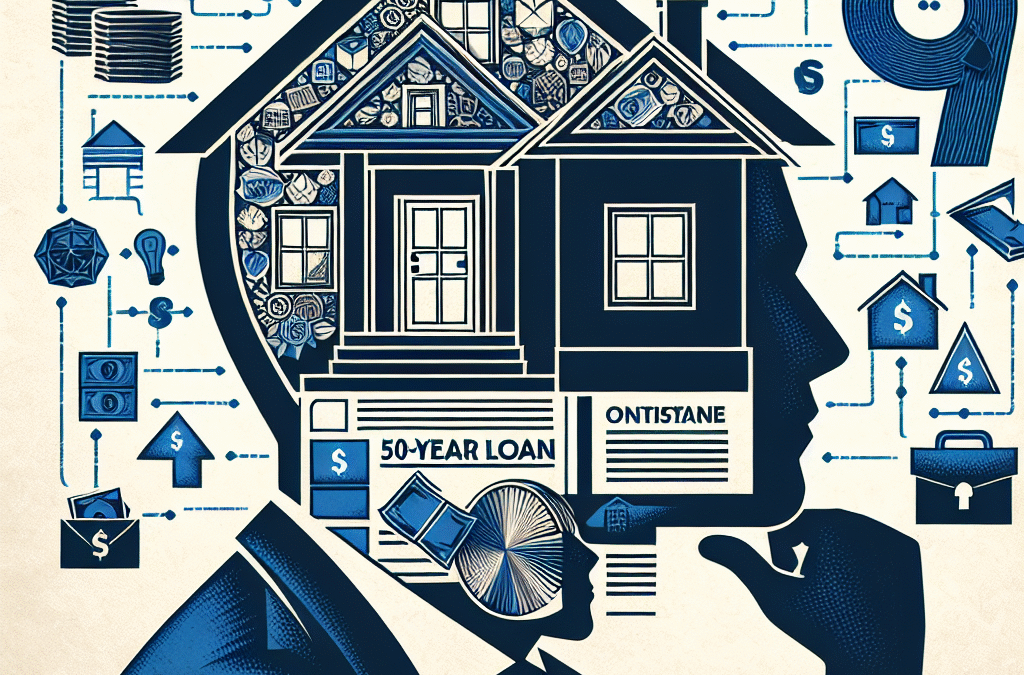
The latest announcement from the White House is a proposed 50-year amortization loan in order to improve home ownership affordability. This proposal has been met with criticism from all sides. The obvious advantage is that the principal portion of the loan payment can be spread over a longer time period and thereby reduce the size of the loan payment. The purists will argue that the amount of interest paid over the life of the loan balloons to unreasonable values. Perhaps the largest criticism of all has been ~~payments~~ 📝that it will only have the effect of pushing housing prices higher.
I personally think that two things would need to happen for that to be true. There is no question that home prices have risen faster than household incomes during the period of 2018–2022. During the pandemic, prices for single-family homes got bid up to unexpected and unaffordable levels. Much of that price increase was the result of the combination of low interest rates and accumulated fast cash that was injected into the economy in those years. When the interest rates rose to more historically balanced real interest rates, those high prices became completely unaffordable. Those same homes would not sustain the high prices in the presence of a 6 or 7% interest rate.
But the market also became a bifurcated market, with 30% of homes selling with no financing at all, which meant that they were not sensitive to interest rates. The argument is that if the amortization is extended to 50 years, it will have the effect of lowering the monthly ownership, which will then cause prices to be bid up even higher, well outside the levels of affordability of ordinary citizens. But it would take the combination of that and lower interest rates, in my opinion, to bid prices up.
So theoretically, while I understand that argument, the reality is I don’t think it’s gonna play out that way for several reasons.
Number one, we don’t know the restrictions ~~be~~ 📝to be applied to these 50-year loans. It’s likely, in my opinion, that they will only apply to first-time homebuyers to make the entry-level homes more affordable. That would enable first-time homebuyers to get into the ladder of home ownership sooner than they may otherwise.
Number two, the impact of a longer amortization is smaller on the monthly cost compared with lower interest rates, so lowering interest rates actually has a bigger impact.
Number three, just because the home has a 50-year loan doesn’t mean that the owner is going to hang on to that house for 50 years. People with 30-year loans are selling before 30 years are up, people with 20-year loans are selling before 20 years, and people even with ten-year loans are hanging on not necessarily for the duration of that loan either.
Fourth, and finally, the most important is the impact of inflation. A 50-year loan is an amazing loan from an investment perspective. The lender is almost guaranteed to take a bath, to come out on the losing end of that loan, and that’s because the devaluation of the currency over that time period is going to be a losing proposition for the lender. They’re likely to get the value of that loan wiped out.
I’ll give you a very simple, concrete example as a historic perspective. My parents bought a home in cash in 1967 for $42,000. It was on a premier street in the most ~~extensive~~ 📝expensive area of our home city. Now that same home would sell 50 years later for about $865,000. That house hasn’t grown, it hasn’t moved, it has the same number of bedrooms, the same number of windows. The intrinsic value of the home is essentially the same.
Now, maybe there was a small amount of market appreciation, but the vast majority of that price appreciation can, in fact, be attributed to the devaluation of the currency. We’re talking about nearly a 20-times increase in price over that 50-year period. So if that home had been purchased instead, being purchased in cash, let’s say with 100% financing, and let’s say that no principal payments were made over that 50-year period, that loan would have gone from 100% financing to a 5% financing merely through the devaluation of the currency.
It’s for that reason that I’m not the least bit bothered by the notion of a 50-year loan. It’s an artificial construct designed to make home affordability in today’s dollars, where that loan is going to be repaid in future dollars that are worth far less than today.
I doubt this loan will find its way into the world of commercial real estate, but if it did, I’d be one of the first to say, sign me up.
As you think about that, have an awesome rest of your day. Go make some great things happen, and ~~WE’ll~~ 📝we’ll talk again tomorrow.
Stay connected and discover more about my work in real estate and by visiting and following me on various platforms:
Real Estate Espresso Podcast:
- 🎧 Spotify: The Real Estate Espresso Podcast
- 🌐 Website: www.victorjm.com
- 💼 LinkedIn: Victor Menasce
- 📺 YouTube: The Real Estate Espresso Podcast
- 📘 Facebook: www.facebook.com/realestateespresso
- 📧 Email: podcast@victorjm.com
Y Street Capital:
- 🌐 Website: www.ystreetcapital.com
- 📘 Facebook: www.facebook.com/YStreetCapital
- 📸 Instagram: @ystreetcapital